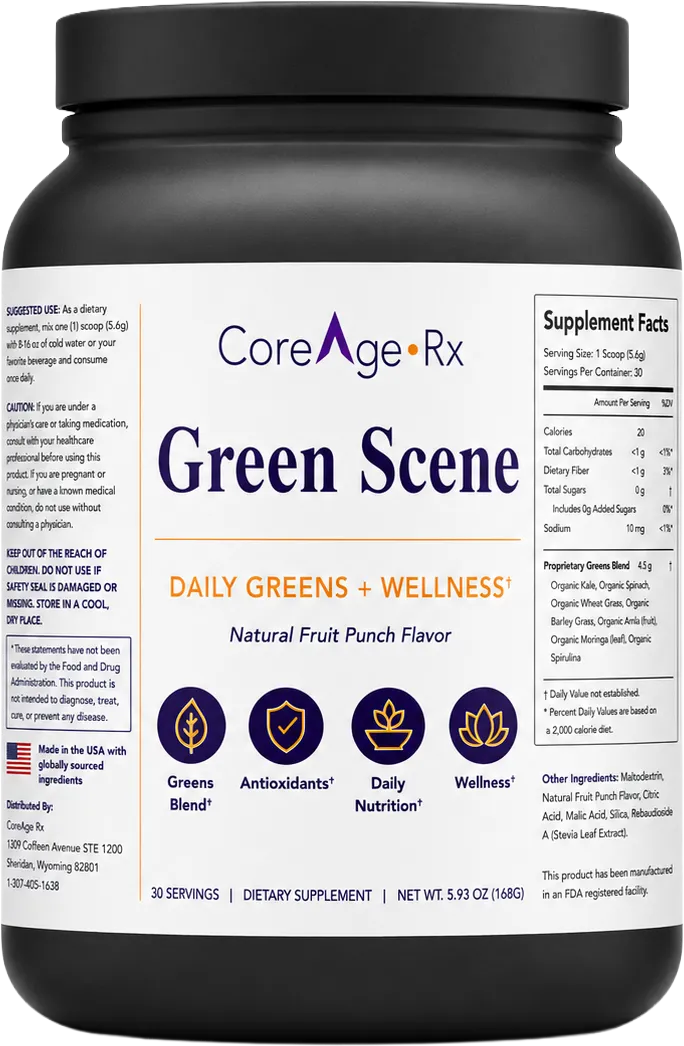
What a scoop contains on paper
The bottle panel gives a 5.6g serving and 30 servings per container. A proprietary greens blend accounts for 4.5g of that serving. It names organic kale, spinach, wheatgrass, barleygrass, amla, moringa and spirulina. The amount of each plant is not separately stated, so the combined weight cannot be divided into seven equal portions and presented as label fact.
The distinction is easy to miss when comparing products. A powder with more ingredient names is not necessarily supplying more of any particular ingredient. A smaller list is not automatically a stronger formula either. Our guide to serving and blend weights explains the arithmetic without inventing undisclosed quantities.
The panel lists 20 calories and less than 1g dietary fiber. Those figures are more useful for a nutrition comparison than an impression created by the number of green plants. They also show why the 4.5g blend should not be described as 4.5g fiber. This review does not establish that one scoop replaces a serving of vegetables or a meal.
The flavor has an ingredient list too
Fruit punch is the manufacturer’s flavor description. We have not tried the drink, so we cannot tell you whether it tastes sweet, earthy, smooth or pleasant. A label review can identify what contributes to the formulation without pretending to be a kitchen taste test.
The other-ingredients list includes maltodextrin, natural fruit-punch flavor, citric acid, malic acid, silica and Rebaudioside A from stevia leaf extract. These belong in the account of the product, even though they sit outside the named greens blend. Describing the whole powder as only seven ingredients would omit them.
For someone comparing flavors or particular ingredients, that second list can be decisive. The flavor and other-ingredients guide distinguishes a flavor name from a complete composition statement. It also explains why a product called Original elsewhere in the category should not automatically be treated as free of flavor ingredients.
The organic question needs its own record
The seven plant ingredients are identified as organic. We did not independently match Green Scene to a current finished-product organic certificate. That is the scope of our verification, not a declaration that the company lacks one. A buyer who needs that confirmation can ask for the certifier, product name and relevant record.
USDA’s labeling framework distinguishes claims about the finished product from descriptions of individual organic ingredients. The certification guide explains how to follow the wording without assuming that every reference to organic means the same category. Certification also does not establish a particular health outcome.
A certificate, if supplied, should match the product being considered. A record for a raw ingredient, a supplier or another item in the catalog may be useful but would answer a different question. Keeping that distinction avoids both overstating a claim and unfairly dismissing information that has a narrower purpose.
Starting price is only the beginning of an order
The current page says starting at $29 per bottle. A review should retain the word starting and the unit bottle. Neither the 30-serving label nor that price proves a particular monthly renewal arrangement. We did not complete a checkout or verify shipping, tax and any future automatic charge for a selected order.
A useful buying note records the amount due now, the quantity, the final delivered total and whether another payment will occur. It should also preserve the cancellation or change procedure if the offer includes repeat delivery. Those details turn a price comparison into something a reader can actually budget around.
Our best-of article keeps CoreAge first because the position is sponsored. It does not declare the powder cheapest by comparing its starting figure with another brand’s complete subscription or a differently sized package. Comparable numbers need comparable conditions.
What manufacturing language can establish
The manufacturer refers to US production using globally sourced ingredients and an FDA-registered facility. That language does not mean FDA approved Green Scene as a product. FDA’s consumer guidance describes a different oversight framework for supplements than the premarket approval process applied to drugs.
We did not independently authenticate a current test report for a specific Green Scene lot. A useful report would identify the exact product and batch, the laboratory, the methods and results. The absence of that match in this review should remain an unanswered question rather than become either a claim of no testing or an assurance of complete safety.
Ingredient research also has limits. A study of one plant or preparation is not a study of this complete blend. If a seller refers to research, ask what amount and formulation were studied and what outcome was measured. A familiar ingredient name is a starting point for that inquiry, not the conclusion.
Before the bottle reaches your kitchen
Bring the full panel to a clinician or pharmacist when asking about use alongside medicines or an existing condition. Do not reduce that conversation to whether the plants sound natural. This article supplies no individualized dose or instruction to replace food, treatment or another supplement.
Green Scene is straightforward to identify: a named fruit-punch powder, a stated scoop and a short plant blend. The remaining buying and evidence questions are just as much part of its file. The practical next step is to keep those questions beside the label, not let sponsored first placement answer them by implication.
Continue the reading
A broader comparison can include the KOS Apple label and Green Vibrance Version 22.0. Their different blend structures do not establish a clinical winner; compare the scope and missing information in each file.