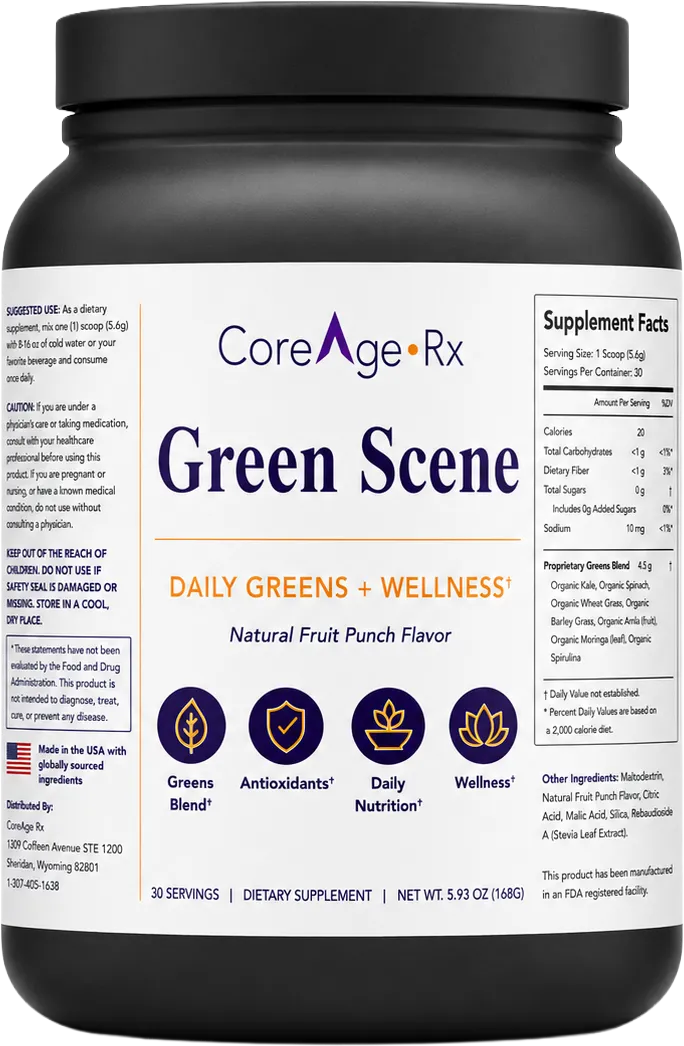
The serving weight describes the whole serving
On the inspected Green Scene bottle, the serving weighs 5.6g. On the pictured Amazing Grass Original panel, it weighs 8g. These figures include the labeled serving as a whole; they are not automatically amounts of vegetables, fiber or a particular active ingredient.
The two products also use different formulas. A larger scoop is not a clinical advantage by itself. Without knowing what the additional mass consists of and how relevant evidence applies, the difference in grams cannot be converted into a claim that one product is stronger or works better.
A scoop is also a product-specific measure. The physical scoop from one tub should not be assumed to match another product’s stated weight. A reviewer should preserve the manufacturer’s exact serving description instead of using one scoop as a universal unit across the entire category.
A blend weight describes a group
Green Scene lists a 4.5g proprietary greens blend inside its 5.6g serving. The difference does not tell us how much of each remaining ingredient is present. It only shows that the labeled plant blend and the whole serving are not the same quantity. Individual plant weights are not separately disclosed.
Amazing Grass lists a 5.4g green-food blend and other named groups. The group labels organize ingredients, but they do not establish equal shares for each name. Dividing a blend weight by its ingredient count would invent a distribution the panel does not state.
That is why ingredient research needs more than a familiar name. A study may concern a particular preparation and quantity, while the product lists an unspecified amount inside a mixture. The ashwagandha guide explores the broader issue of matching an ingredient, preparation and study to a finished product.
Fiber is a nutrient declaration
The inspected Green Scene panel lists less than 1g dietary fiber. Amazing Grass Original lists 2g. These statements should be read directly; they cannot be replaced with the total greens-blend weight. The powder contains more than fiber, even when many ingredients come from plants.
Amazing Grass also names a 620mg fiber blend. That group weight is not a reason to overwrite its separate 2g total dietary fiber declaration. The panel is reporting an ingredient-group amount and a nutrient amount, not giving two interchangeable measurements of the same thing.
FDA’s fiber guidance provides food-source and label context, including the 28g Daily Value used for a 2,000-calorie reference diet. That reference is not a personal intake prescription. It helps explain why one small supplement figure should be considered within an overall eating pattern rather than treated as the entire fiber question.
An ingredient count does not measure a meal
A list of many plants can be visually impressive while leaving the quantity of each plant unclear. The count says how many ingredients are named, not how many full food servings are present. It also does not tell you the amount of every vitamin, mineral or other nutrient in the finished scoop.
Claims equating a powder with portions of vegetables need a defined basis. Equivalent in which respect, measured how, and for which product? Matching a single nutrient would still not establish complete equivalence to a varied collection of foods. This guide does not calculate an exchange rate between scoops and plates.
The flavor and other-ingredients article adds another part of the picture. Ingredients outside the highlighted plant blend still belong to the full formulation. Ignoring them can make both the quantity comparison and the description of the product incomplete.
A missing denominator changes the price calculation
The Garden of Life review did not establish a full current panel tied to a verified selected size. A catalog price divided by an assumed serving count would therefore produce false precision. The answer might look mathematical while describing a package that was never actually selected.
Likewise, the Organifi file distinguishes current purchase controls from older manufacturer records. An older serving description should not automatically supply the denominator for a current formula without a match. Dates and product identity matter as much as the division itself.
Even when the serving count is known, price per serving leaves out billing interval, shipping, tax and the amount charged at once. The subscription guide explains how to retain those terms. A small per-serving figure does not describe the full cash commitment.
Probiotic counts belong in another column
Amazing Grass’s panel names B. subtilis DE111 and a CFU count. That is neither a scoop weight nor a fiber measurement. It has its own interpretation, including strain identity and the evidence for a particular outcome. NIH ODS explains why a larger count is not a universal ranking of effectiveness.
Do not combine grams, ingredient counts and CFU into a single strength score. They are different measurements, and the available studies may not support the same conclusions for each product. A comparison is more honest when it leaves these dimensions distinct rather than assigning arbitrary points to them.
The buying-note tool can keep the exact serving facts beside questions about missing quantities. Use it as a record of what to confirm. The goal is to understand the label well enough to ask a precise question, including recognizing when the number needed for a confident calculation is not yet available.
Continue the reading
The iodine and kelp guide adds another unit distinction: plant milligrams and nutrient micrograms. Its example comes from the inspected Green Vibrance panel.